ARTICLES
Find Value: Why Most Companies Can't Name Their Own
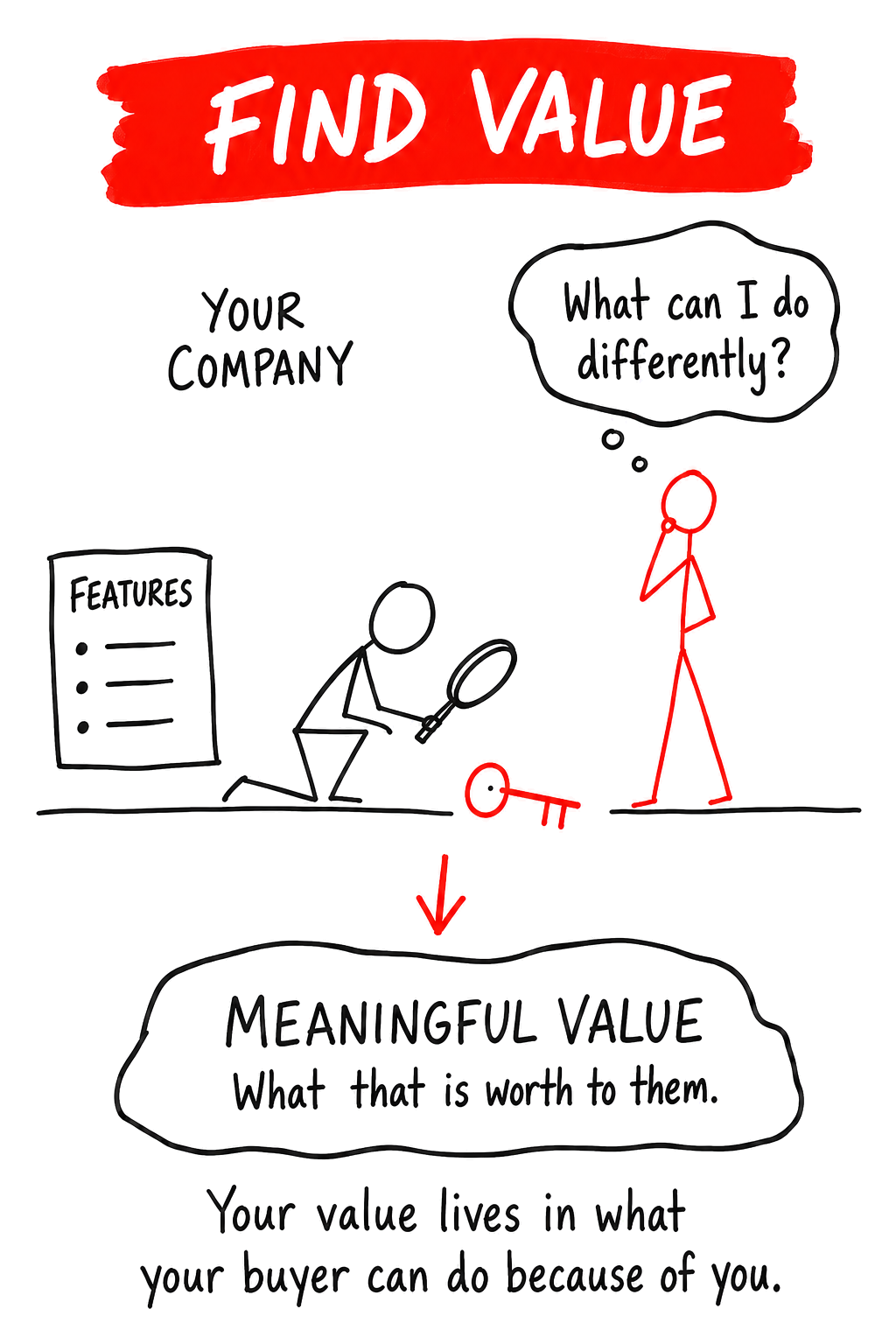
Your value was never in your product. It lives in what your buyer can suddenly do because of you — and what that's worth to them.
By Bruce Scheer, Inspire Your Buyers®
Your value was never in your product. It lives in what your buyer can suddenly do because of you, and what that is worth to them.
Most companies never find it, because they search under the wrong light.
There’s an old teaching tale about a man who finds his neighbor on hands and knees under a streetlamp late at night, searching the dirt. “What did you lose?” “My house key.” So the man kneels down and helps, and together they comb every inch of ground in the pool of light. Nothing. Finally he stops. “Are you sure you dropped it here?” “Oh, no,” the neighbor says, nodding toward his dark doorway down the street. “I’m pretty sure I lost it over there.” “Then why are we looking here?” “Because the light is so much better over here.”
That is how most companies look for their value. They search their own product, because that’s where the light is. The trouble is the value was never in the product. It was dropped somewhere else, over in the dark, where the buyer is standing.
The Big Problem: searching under the streetlight
At Seattle Tech Week this year, I ran a value-positioning workshop that was so oversubscribed I ran it three times. Sharp founders, former senior go-to-market operators from Microsoft, Meta, AWS, Google. Most could recite their feature list in their sleep. Almost none were clear on the differentiated value they were bringing to their target market. The room got quiet fast.
That gap, “I understand my product” and “I don’t know my differentiated value,” is not a Seattle problem. It hits early-stage startups and mature companies with mature products alike. This is one you can’t delegate to AI. It’s a human judgment and market insight problem, and an opportunity for the few who get it right.
Stay under the streetlight, and you sound like everyone else. Buyers already struggle to see a difference: 64% say they can’t distinguish one brand’s digital experience from another’s (Gartner). I watched a company get a signature feature copied by a competitor in one week. If your differentiation is a feature, it has the shelf life of a feature.
The Risks: what feature-talk costs you
The deal doesn’t go to a competitor. It stalls. 86% of B2B purchases stall somewhere in the buying process (Forrester), and 40 to 60% of qualified deals end not in a loss to a rival but in “no decision” (The JOLT Effect). The buyer never saw a reason worth the risk, so they did nothing.
That’s the real cost. Not a lost bake-off. A buyer standing in the dark, while you read your spec sheet under the light.
The Desired Outcome: value in the light
When you get your positioning right, the buyer doesn’t have to work to understand why you matter. They see it, they see themselves in it, and they can carry it into a room you will never be in. April Dunford articulated this beautifully in her recently updated classic, Obviously Awesome, currently my favorite book on positioning.
The edge is measurable. When buyer and seller align on the problem to be solved, win rates rise by 38% (Emblaze), yet sellers and buyers misread that core problem more than half the time, an average 54.5% misalignment after they’ve talked (Emblaze). Getting positioned around real value is what closes that gap, before the commoditizing starts.
Obvious doesn’t mean loud. It means found.
The Path: how to find value
This is the process I now teach as Find Value, the first of the three moves in how I work with clients.
Finding value is an act of positioning. Get it right, around your meaningful value for buyers and the unique capabilities behind it, and the value stops hiding. After 30 years of doing this, here’s how I teach it: six ingredients, in order, starting with the market, because your buyer sizes you up against the world they already live in before they ever weigh what only you can do.
Overall market context. The trends and thought leadership your buyer is already swimming in. Understand their world first.
Alternatives. What your buyer does to solve their problem without you, including the most popular option of all: nothing.
Unique capabilities. What only you can bring together. Not a feature, but what you enable your buyer to do that no one else does.
Meaningful value. Because they can do that, what’s the payoff in their own dollars, the quantifiable business value their CFO will eventually need to see.
Target customers. Who feels the problem most, and can actually act on it with you. So many segments, so little time, in the spirit of Geoffrey Moore’s Crossing the Chasm.
Appropriate category. Where you sit in your buyer’s mind, so they have a frame for what you are.
Ingredients three and four are the heart of it. A feature is what you built. A capability is what the buyer can suddenly do because of it. Competitors copy the first in a week. The second is a lot harder to lift, because it’s usually a unique collection of features working together.
Here’s how that looked with an analytics company I worked with, years back. Companies that adopted data-driven decision making were roughly 5 to 6% more productive and profitable than their peers (Brynjolfsson, Hitt and Kim). Everyone wanted to be data-driven. Almost nobody could be. We didn’t lead with the software. We led with the unique capability: giving people who aren’t analysts the ability to see and question their own data, no code, one question breeding the next. We named that state self-reliance, and self-reliance became the category. Data usage at that company climbed from 8% of the people who wanted it to 80%. Notice what carried the story. Not the visualization engine. What the buyer could suddenly do, and what that was worth to them.
That’s your moat, too. Anyone can copy a feature, and with AI they can do it faster than ever. What they cannot easily copy is a clear, hard-won line from your unique capability to the meaningful value it creates for a specific buyer. Very few companies build that line, which is exactly why it defends you.
Next Steps
Can you name it? The unique capability you enable for your buyers, and the meaningful value it creates for them?
- Run your positioning against a simple acid test: does the buyer see the value, see themselves, and see the value for themselves? Miss any of the three, and you’re still under the streetlight.
- If you want help finding it, that’s the work I do. Let’s talk about getting your value out of the dark and into the light.
- I’d love your feedback: how are you doing at crystallizing your positioning? Hit reply, comment, or connect with me on LinkedIn.
Your value was never under the streetlight. It’s out in the dark, right where your buyer is standing. Go find it.
Author
Bruce Scheer is the author of Amazon Best Seller Inspire Your Buyers. He helps B2B revenue teams find and name the value their buyers can see, defend, and retell without a seller in the room. Connect with him on LinkedIn.
Research cited
- Gartner, 2020: 64% of B2B buyers cannot distinguish one brand’s digital experience from another’s.
- Forrester, The State of Business Buying, 2024: 86% of B2B purchases stall during the buying process.
- The JOLT Effect, Dixon and McKenna, 2022: 40 to 60% of qualified deals end in “no decision.”
- Emblaze, 2024: win rates rise 38% when sellers and buyers align on the problem, with an average 54.5% misalignment after discussion.
- Brynjolfsson, Hitt and Kim, 2011: firms with data-driven decision making show productivity and profitability roughly 5 to 6% higher than peers.
For more sourced, graded B2B statistics like these, see the 2026 B2B Narrative Statistics page.
Frequently asked questions
What does it mean to “find your value”? Finding value is an act of positioning: naming the unique capability only you enable for your buyer, and the meaningful value that capability creates for them in their own terms of time, money, risk, and growth.
Why can’t a feature be your differentiation? A feature has the shelf life of a feature. What can’t be copied is the hard-won line from your unique capability to the meaningful value it creates for a specific buyer. That line is your moat.
What’s the difference between a feature and a capability? A feature is what you built. A capability is what your buyer can suddenly do because of it.
How do I know if my positioning is working? Run it against the acid test: does the buyer see the value, see themselves, and see the value for themselves? If any of the three is missing, you’re still searching under the streetlight.