ARTICLES
Is Your Selling Conversation Apropos? The APROPOS Framework for Sales Meetings That Move
Most B2B sales meetings are full of motion, no bearing. What they need isn't a better opening line — it's a compass.
By Bruce Scheer, Inspire Your Buyers®
Picture your last big meeting from the buyer’s chair. A seller opens their deck, and you’re not lost exactly, you’re just not going anywhere. No sense of where the conversation is headed or why it should matter to you today. That’s most B2B sales meetings: full of motion, no bearing.
What a conversation like that needs isn’t a better opening line. It needs a compass.
By apropos, I mean genuinely, almost uncomfortably, relevant to the person across the table. Built to move them through a flow, cognitive and emotional, that leaves them ready to move forward with you. Not pitched at. Oriented, then moved.
If you’re a revenue leader trying to get to revenue at scale, or a founder trying to get to revenue as fast as possible, that distinction is everything. It’s the difference between a calendar full of “great conversations” that go nowhere and a pipeline that actually moves.
The Big Problem: a conversation with no compass
Here’s the uncomfortable part. Most first conversations aren’t apropos. They’re seller-centric. We show up, we talk about us, we spray features, and we call the monologue a meeting. No wonder 71% of buyers describe their interactions with reps as frustrating (SBI Growth, 2024).
I’ve seen no shortage of frameworks for how to run these conversations, from vendors and consultancies, some grounded in science, plenty not. After more than 25 years building enterprise-level, multi-stakeholder selling conversations, I’ve landed on one pattern that reliably works. It starts with a single word: APROPOS.
The Risks: what a directionless meeting costs you
Think about what’s at stake. You finally land the moment-of-truth meeting with an executive. You get one shot. Spend it talking at them and you don’t just lose the deal, you lose the time, theirs or yours. And when you’re racing to revenue, time is the one thing you can’t get back.
The math is sobering: 40 to 60% of qualified B2B pipeline now ends in “no decision,” not a competitive loss (The JOLT Effect, 2022). The meeting that goes nowhere is the norm, not the exception. And the buying group behind that meeting is already strained: 74% of B2B buying teams show unhealthy conflict during the decision, while teams that reach consensus are 2.5x more likely to report a high-quality deal (Gartner Sales Survey, 2025). A seller-centric meeting doesn’t calm that conflict. It adds to it, one more voice in the room with no bearing of its own.
The Desired Outcome: a room that moves
Now picture the opposite meeting. The executive leans forward instead of checking their phone. They correct you on a detail, which means they’re actually tracking. Somewhere past the halfway mark they say the thing you were hoping to hear without prompting: “so what would that actually look like for us.” That’s not persuasion. That’s someone who now has their bearings, moving toward a decision under their own power.
Set it up right, and the room changes. Gong analyzed thousands of sales calls and landed on a winning talk-to-listen ratio of about 43:57. Hold no more than half the airtime, ideally a little less. And that relevance is what buyers reward: 74% of executive buyers choose the seller who delivers insight first (Forrester, 2024). Here’s what’s new: AI makes the prep that earns that balance fast. You can do the homework in minutes, talking to insiders, learning the account’s language, learning who you’re actually meeting with, so you walk in with enough context to be useful in their world, not yours.
The Path: the eight-point APROPOS compass
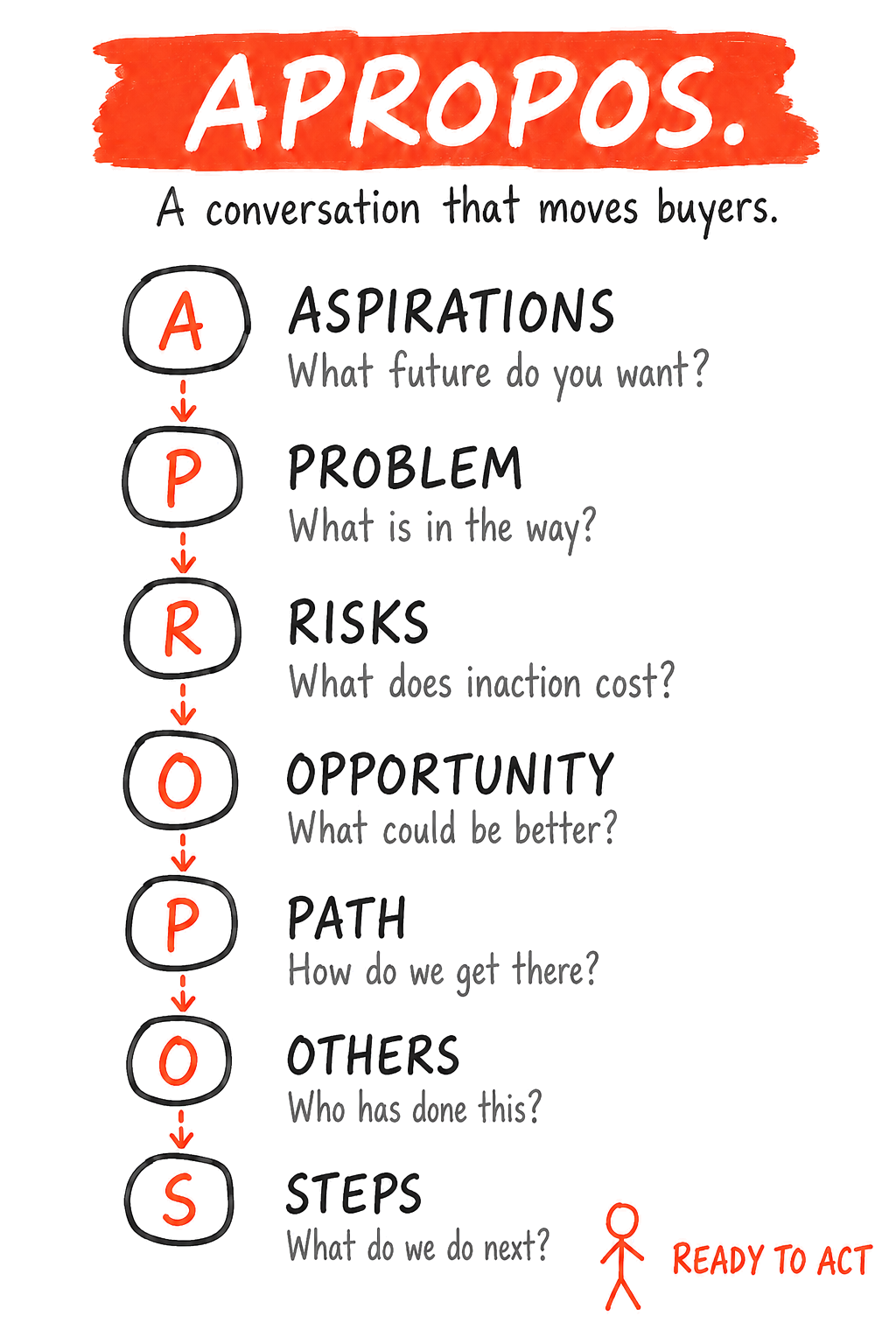
Open with Meeting Purpose, then move through the seven APROPOS beats. Eight moves, one direction: from where the buyer is standing to ready-to-act.
Meeting Purpose. Earn the right to be there. Why are we here, and what do we hope to accomplish together? Set it, and get their nod before you go further.
Aspirations. In the area where you can help, what are they reaching for? Their goals over the next year. You’re not selling yet. You’re aligning on the future they want.
Problem. What’s getting in the way? What about their current state keeps them out of the posture they need, in their own words?
Risks. What does it cost to leave that problem in place? Surface the price of inaction, quietly and honestly. This is where urgency is born.
Opportunity. Now the turn. What does the better outcome look like? Paint the future on the other side of the problem.
Path. Only now do you bring your solution, as the proven route to that outcome, not a feature dump.
Others. Show them they’re not first. Proof, stories, social validation that people like them made this move and won.
Steps. Don’t fumble at the goal line. Lay out the typical steps for getting started, and invite them with a clear, concrete next step.
That’s the whole compass. Every needle points the same direction: toward a buyer who’s oriented instead of pitched at.
APROPOS is one half of what I call Communicate Value in my client work; the other half is narrative consistency across every touchpoint, not just the selling conversation.
It’s the backbone of the conversations I’ve built for teams closing some of the biggest, hardest deals in tech. Structure like this isn’t a nice-to-have. It’s the first thing I look at when I assess a company’s narrative health: does your narrative flow in a way that inspires action? I lay out the full structure in my book, Inspire Your Buyers.
Next Steps
- See how your structure scores with the free Narrative Assessment.
- Grab Inspire Your Buyers and study the structure: amazon.com/dp/B0BZF8MPPJ
- If you want help building this into your team’s meetings, let’s talk.
One more thing. Go back and reread what you just read. I earned the right to be here in the opening. I aligned you on what a better meeting looks like. I named the problem with most sales meetings, and the risk of leaving it alone. I showed you the opportunity, walked you the compass itself, pointed to proof in the work I’ve built for teams closing the hardest deals in tech, and gave you a next step.
You just went through APROPOS. If it felt relevant, if it moved you even a little toward doing something about your next meeting, that’s not an accident. That’s the compass working, on you. And that’s exactly what it does for your buyers.
Don’t hand your next buyer a pitch. Hand them a compass.
Author
Bruce Scheer is the author of Amazon Best Seller Inspire Your Buyers. He helps B2B revenue teams build selling conversations their buyers can act on, using the APROPOS framework and the broader narrative structure that moves big, multi-stakeholder deals forward. Connect with him on LinkedIn.
Research cited
- SBI Growth, 2024: 71% of buyers describe their interactions with reps as “frustrating.”
- The JOLT Effect, Dixon & McKenna, 2022: 40 to 60% of qualified B2B pipeline ends in “no decision.”
- Gartner Sales Survey, 2025: 74% of B2B buying teams show unhealthy conflict during the decision; teams reaching consensus are 2.5x more likely to report a high-quality deal.
- Gong Labs, sales-call analysis: a winning talk-to-listen ratio of about 43:57.
- Forrester, 2024: 74% of executive buyers choose the seller who delivers insight first.
For more sourced, graded B2B statistics like these, see the 2026 B2B Narrative Statistics page.
Frequently asked questions
What does APROPOS stand for? An acronym for the seven beats that follow an opening Meeting Purpose: Aspirations, Problem, Risks, Opportunity, Path, Others, and Steps. Eight moves in total, one direction.
What is a good talk-to-listen ratio in sales calls? Research from Gong on thousands of sales calls points to a winning ratio of about 43:57. The seller should hold no more than half the airtime, ideally less.
Why do most first sales conversations fail? They’re seller-centric. The rep talks about themselves and sprays features instead of being relevant to the buyer, and a substantial share of qualified pipeline ends in “no decision” rather than competitive loss.
How is APROPOS different from a standard sales pitch? A standard pitch leads with the product. APROPOS holds the solution until the Path beat, after first aligning on aspirations, problems, risks, and desired outcomes, sequencing through cognitive and emotional stages so buyers arrive ready to act rather than defended.