
ARTICLES
Return on Experience: The Biggest Return in B2B Isn't What You Sell
The buyer is doing the hardest job in the whole deal, mostly without us. There's a real, measurable return waiting for the team willing to help.
By Bruce Scheer, Inspire Your Buyers®
The buyer is doing the hardest job in the whole deal, and they’re doing it mostly without us.
Building consensus across a dozen colleagues. Clearing procurement, InfoSec, and finance. Defending a decision they will live with long after we’ve moved on to the next quarter.
Picture a football drive where your team moves the ball beautifully for three quarters, then jogs off the field and leaves the buyer to carry it in alone. That’s most B2B selling today. That work, the actual experience of buying, is where most of the value gets won or lost. And right now most of us aren’t helping with it at all. There’s a real, measurable return waiting for the revenue team willing to help with that hard work instead of just selling at the people doing it. I call it Return on Experience. ROE for short.
The Big Problem: the deal is mostly decided before you show up
Look at how a modern purchase actually unfolds, and this stops being a matter of opinion. 6sense studied close to four thousand buyers and found that 94% of buying groups rank a shortlist before they ever contact sales. The vendor in the top spot wins about 80% of the time, and 95% of eventual winners were on that shortlist from day one. Most buyers don’t even reach out until they’re two-thirds of the way through their journey.
So when you lead with a product pitch, you’re often walking into a fight that was settled weeks ago. What earns you the top spot isn’t the slickest feature set. It’s helping early, and helping for real. 74% of executive buyers go with the seller who first added value and shaped their thinking about the problem (Forrester). First, not best.
The Risks: what a poor buying experience costs
86% of B2B purchases stall somewhere in the process (Forrester, 2024), and 81% of buyers end up dissatisfied with the provider they chose. You can win the deal and still let the buyer down.
This is the real competition. Not the other logo on the shortlist, but selling that shows up late and adds nothing to the hard part.
The Desired Outcome: ROE is engineered, not customer experience
Let me be sharp about what ROE is not, because the word “experience” invites confusion. It’s not your reps being friendly. It’s not fast email replies. It’s not a slick portal, brand polish, a nice dinner, or swag. Those things are pleasant, and none of them move a stalled deal.
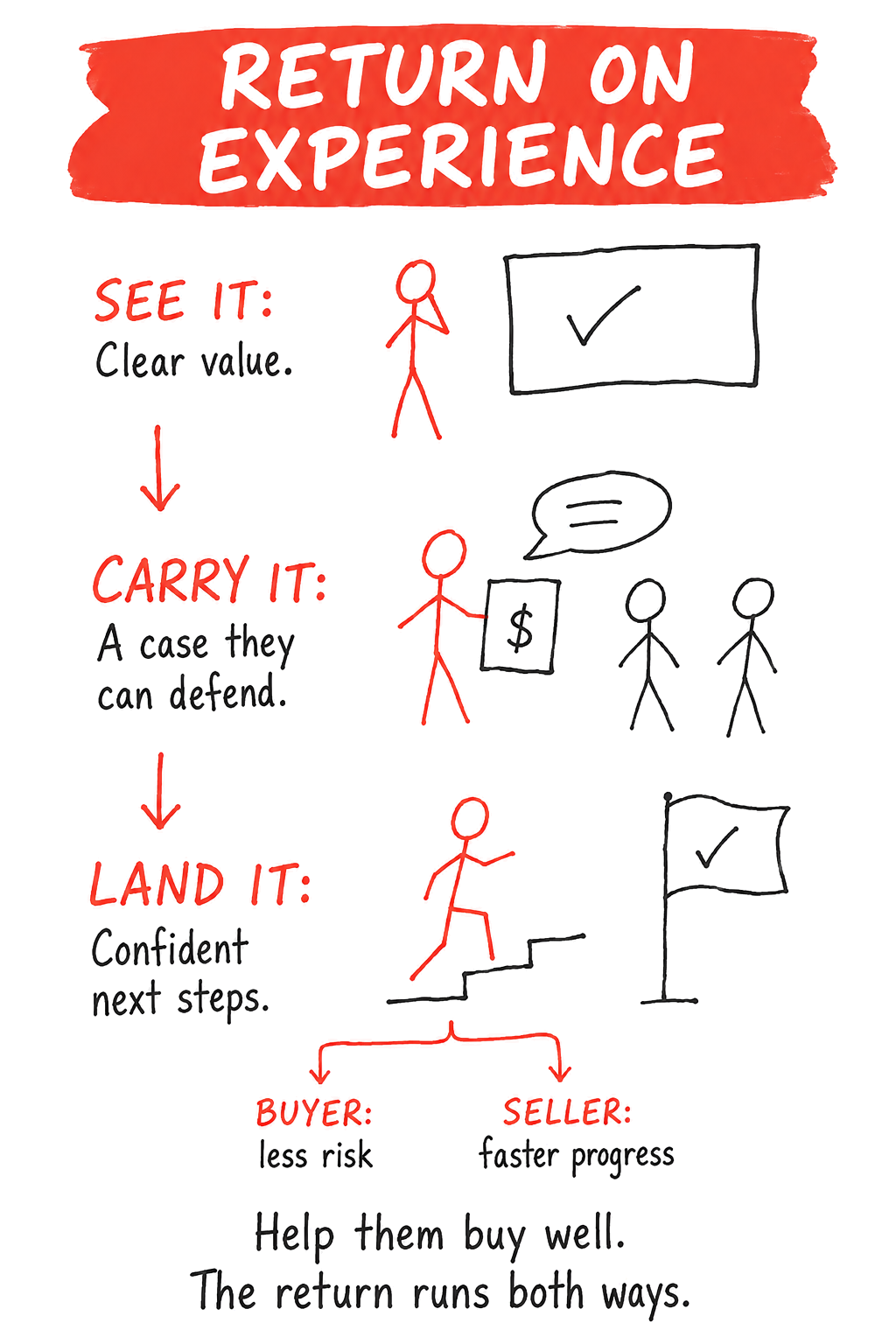
ROE is engineered buyer progress: the deliberate moments you design so a buyer can see value, carry it through their own organization, and move with confidence.
Part of the return is genuinely emotional, the confidence and relief a buyer feels when the path finally looks clear. Personal value moves buyers more than most sellers credit: buyers are 50% more likely to buy, and up to 8x more likely to pay a premium, when they feel personal value in the purchase (Google/CEB/Motista). But the experiences that move deals are built on purpose, not wished into being. In Inspire Your Buyers I describe value in three layers, emotional, operational, and business, and the best buying experiences deliver all three deliberately.
Two examples from my own work make it concrete. Years back, my team built a campaign for Alcatel-Lucent around a virtual hotel. Buyers could walk through it and see the guest experience, the operational changes behind the scenes, and the business value of both, all in one place. That wasn’t a feeling. It was a constructed experience that showed buyers value no slide could. It won CEB’s B2B Marketing Campaign of the Year, and more to the point, it worked.
With NetApp, we scaled a Cloud Value Management workshop built to do one thing: get the buyer’s own stakeholders aligned before anything could move. It drove new business and expansion by engineering a moment of shared clarity for the whole buying group. Deliberate. A built experience with a built-in return.
The Path: three jobs of a buyer-enabling revenue team
See it. Before anyone can buy, they have to see the value clearly. Most buyers can’t, because they’re buried under conflicting information from every vendor and every internal voice. Your job is to cut through it: trade the noise for one clear picture of the problem, the outcome, and the path between them. In practice, that’s an art-of-the-possible workshop, a value session built around the buyer’s world instead of your feature list, or a demo framed by their outcome rather than your specs. A buyer who sees clearly can act. A buyer who can’t, stalls.
Carry it. Your champion has to win arguments in rooms you will never sit in. If the value can’t travel without you, it dies in the hallway between your meeting and theirs. So arm them. For high-consideration purchases, the business case and ROI analysis are a big part of the buying experience, so build the ROI with your champion, not for them, and they’ll own it in the room. It matters more by the month, too: 57% of buyers now expect to see ROI within three months (G2). Then give them what they need to align their own stakeholders, the way the NetApp workshop did. The test is simple: could your champion make the case, well, with you out of the building?
Land it. The most common blunder in selling is a rep who carries the ball the length of the field, then fumbles at the goal line, ending the meeting with “So, where should we go from here?” and handing control straight back to the buyer. Do the opposite. Hard-code your next steps. It’s the one part of selling to package and standardize, because a clear, confident set of next steps is itself a powerful experience. “Based on my experience, I’d suggest we take these three steps next. Does that work for you?” Give each step a purpose, the right people, the decisions to be made, and something the buyer walks away holding.
Why the return runs both ways
This is why the work is worth it. When you engineer the buying experience, the return lands on both sides of the table. Your buyer gets clarity instead of fog, a decision they can defend, and value they begin feeling sooner. Your revenue team gets win rates that climb roughly 38% when buyer and seller truly agree on the problem (Corporate Visions), deals that grow, and discounting that shrinks, because a confident buyer doesn’t need a price cut to feel safe.
And the whole thing accelerates: faster time to value for the customer, faster cash into the business for you. One experience, two returns.
Next Steps
Pull up your last three stalled deals and ask one honest question: did we help them buy, or did we just sell at them and wait?
- Run the see it, carry it, land it test against those deals.
- If you want help engineering the buying experience for your team, let’s talk.
- I’d love your feedback: where is your Return on Experience hiding? Hit reply, comment, or connect with me on LinkedIn.
Whatever sits in the gap between selling at your buyer and helping them buy is your Return on Experience. Right now, it’s sitting there unclaimed.
Author
Bruce Scheer is the author of Amazon Best Seller Inspire Your Buyers. He helps B2B revenue teams engineer the buying experience that turns a stalled deal into a defensible decision. Connect with him on LinkedIn.
Research cited
- 6sense, buyer study of ~4,000 B2B buyers: 94% of buying groups rank a shortlist before contacting sales; the top-ranked vendor wins about 80% of the time; 95% of eventual winners were on the shortlist from day one.
- Forrester, The State of Business Buying, 2024: 74% of executive buyers go with the seller who first added value; 86% of B2B purchases stall in the buying process; 81% of buyers are dissatisfied with the provider they chose.
- G2, 2024 Buyer Behavior Report: 57% of buyers expect ROI within three months of a purchase.
- Corporate Visions, 2024: win rates rise roughly 38% when buyer and seller align on the problem.
- Google/CEB/Motista, 2013: buyers are 50% more likely to buy, and up to 8x more likely to pay a premium, when they feel personal value in the purchase.
For more sourced, graded B2B statistics like these, see the 2026 B2B Narrative Statistics page.
Frequently asked questions
What is Return on Experience (ROE)? The return a revenue team earns by engineering the buying experience, deliberately helping the buyer see value clearly, carry it through their organization, and move with confidence, rather than the return from a slicker portal or friendlier rep.
Why is the buying experience more important than the pitch? Most B2B buying groups rank a shortlist before ever contacting a salesperson, and the vendor who added value first, not the one with the best offering, tends to win. By the time a pitch happens, much of the decision is already made.
What are the three jobs of a buyer-enabling revenue team? See it: help the buyer see the value clearly through the noise. Carry it: arm the champion to defend the case in rooms you’ll never enter. Land it: hard-code clear next steps instead of handing control back to the buyer.
Does engineering the buying experience only help the buyer? No. The return runs both ways: buyers get clarity and confidence, while sellers see higher win rates, less discounting, and faster time to contract.