ARTICLES
Value Buying: Closing the Gap Where Deals Die
Your deal is actually won or lost when your champion is alone in a room you'll never enter, fighting the internal fight without you.
By Bruce Scheer, Inspire Your Buyers®
It’s 9pm, and your champion is still at it, fighting for you.
Not in a meeting with you. Alone, at the kitchen table, building a slide. The slide that has to survive procurement, satisfy the CFO, answer InfoSec, and somehow get eight stakeholders, each defining success differently, to nod at the same time. You sold them weeks ago. But this part, the hard part, they’re doing without you. And nobody handed them a map.
That moment, the champion alone with the internal fight, is where your deal is actually won or lost — not in your demo, not in your pricing, but in their experience of trying to buy.
The Big Problem: we’ve been selling the wrong kind of value
Ray Makela and the team at SBI found that for bold, high-conviction decisions, 59% of the influence comes from the buying experience itself, and only 41% from the offering. How you help someone buy matters more than what you’re selling.
So you’d think we’d pour everything into that experience. We don’t. 67% of B2B buyers now say they’d rather buy with no sales rep at all (Gartner). That’s not buyers being antisocial. It’s a verdict. They’d rather go it alone than sit through one more conversation that adds nothing to the hardest part of their job.
Here’s the real problem. Buyers just aren’t seeing the value, and they certainly aren’t getting the value they need to be successful. The proof is brutal: as many as 60% of qualified deals end in no decision at all, lost to nothing but inertia (The JOLT Effect).
Somewhere along the way, the category shrank the word “value.” It came to mean our value: the benefits, the ROI, the innovation, the competitive edge. Call it solution value. It’s real, and it matters, but it’s value as the seller sees it. The buyer is sitting somewhere else. True value is what the buyer receives: the solution, yes, but also the experience of buying it and the outcomes they live with long after. Call it buyer value. Karl Albrecht had this right back in 1992, in his seminal book, The Only Thing That Matters. Value was never the vendor’s ROI deck. It was always the customer’s.
The Risks: what the value fog costs you
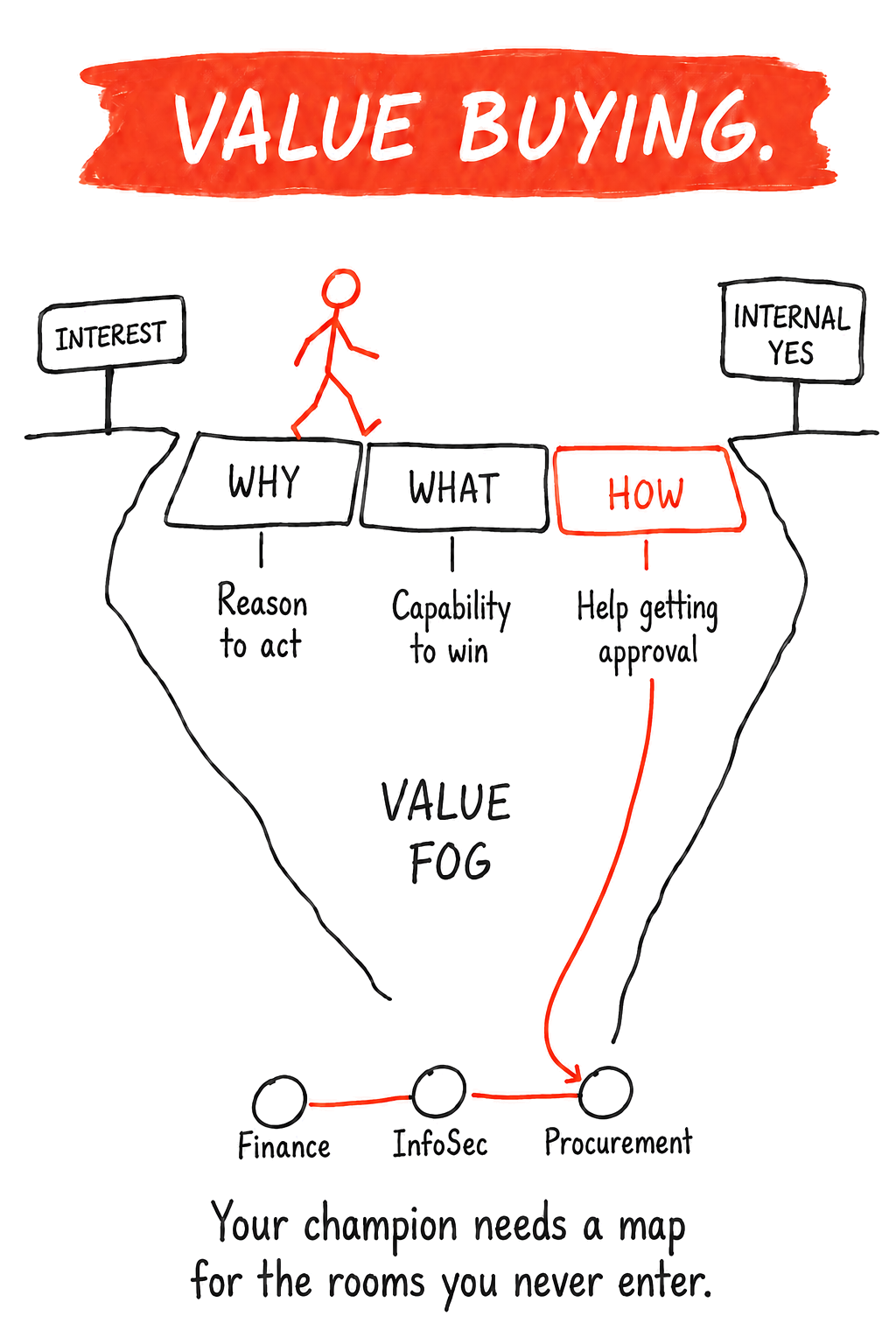
For thirty years, value selling mastered solution value, the why and the what. Why the buyer should care, and what they need to win. But it went quiet exactly where buyer value gets hard: the how. How does your champion get a sprawling committee to yes? How do they clear procurement, InfoSec, finance, and the governance board? How do they win the fight in rooms you’ll never enter?
That blank space has a name. I call it the Value Fog. When the value is clear, the decision is near. When it isn’t, the deal parks in the fog.
Think about your last complex deal. Ten or more people on the buying side, each with their own definition of success. Your champion gets it. But your champion isn’t the one who signs. They carry your value into a dozen rooms you’ll never enter, and somewhere in the fog, it gets dropped. That fog is measurable: 74% of B2B buying teams show unhealthy conflict during the decision, while teams that reach consensus are 2.5x more likely to report a high-quality deal (Gartner Sales Survey, 2025). Forrester finds 86% of B2B purchases stall somewhere in the buying process.
That’s a buying problem, not a selling one, and nobody’s been arming the buyer to solve it.
The Desired Outcome: from Value Fog to Valueocity
Imagine the fog lifting, and imagine finally handing your champion the map you never gave them at the start. Your champion sees the value clearly, believes it in their bones, and walks into every internal room confident that the initiative will be approved and will actually succeed. They’re armed with what they need, when they need it, ready to answer the hard questions and clear the forms lickety-split.
I call that state Valueocity. It’s the moment value moves with velocity, because the person carrying it is convicted and equipped. Valueocity is what gets deals across the line. The Value Fog is what keeps them parked.
The Path: Value Buying, the trifecta
This is the work I’ve come to call Value Buying: the discipline of delivering buyer value across the whole journey. It borrows a page from Simon Sinek and turns it inside out. Start with why, yes, but not your why. Your buyer doesn’t care about your why yet. Start with their why. What are they trying to achieve? What does inaction cost them every month it drags on, and every year after?
Then the what. What capabilities do they actually need to win, and how does your solution help them gain those capabilities?
And then the part the category forgot: the how. How does your champion get every stakeholder to say yes, or at least not say no? How do they clear the internal gates, free up the budget, and walk procurement and InfoSec through without the deal dying in committee?
Why, what, and how. That’s the trifecta. Value Selling helped shape the first two. Value Buying completes the set. And notice where that puts the real selling: it doesn’t happen in your meeting. It happens later, inside the buyer’s building, when your champion stands up and makes the case without you in the room. Tom Williams offered a memorable observation: the real selling starts after the customer says yes. That’s the territory Value Buying is built for.
I’m not the only one waving a flag over the how. Brent Adamson’s book, The Framemaking Sale, pushes deeply into this territory, and it’s well worth your time.
Proof: the Microsoft and HP Frontline Partnership
Years back, my team took on the Microsoft and HP Frontline Partnership. We helped frame up eight joint go-to-market solutions between two giant organizations, with every kind of internal complexity you can imagine. One of the most stressful initiatives of my career.
We could have stopped where most do: a sharp value message and a tidy business case. The why and the what. Instead, we leaned hard into the how, aligning the joint business case and activating the field, equipping sellers and buyers to actually move the deals through. One of the most effective ways we delivered on the how was a series of executive briefing sessions for qualified prospects. Win rates on those multimillion-dollar enterprise deals climbed past 50%. Unheard-of success. The work earned HP’s Marketing Circle Award.
It wasn’t a better pitch that did it. It was refusing to abandon the buyer at the hard part. The research backs the pattern: when buyer and seller genuinely align on the problem, win rates jump roughly 38% (Corporate Visions). Value that crosses the why, the what, and the how doesn’t just feel better. It closes.
Next Steps
If you’re a revenue leader staring at a pipeline full of deals that won’t move, ask yourself an honest question. Are you raising the value across all three, why, what, and how, or handing buyers half a map and hoping they find their way through the Value Fog?
- When you’re ready to build that muscle on your team, let’s talk.
- I’d love to hear what you think. Push back. Add to it. Tell me where I’m wrong. Hit reply, comment, or connect with me on LinkedIn.
The deals dying in the fog aren’t lost to a better competitor. They’re lost to a buying experience that ran out of value right when the buyer needed it most. Close that gap, and you don’t just win more — your buyers do too.
Author
Bruce Scheer is the author of Inspire Your Buyers. He helps revenue teams make value clear enough for buyers to defend internally and get approved. Connect with him on LinkedIn.
Research cited
- SBI Growth Advisory, “Drive Bold Purchase Decisions with Headway Selling,” 2024: for bold purchase decisions, the buying experience drives 59% of the decision versus 41% for the offering.
- Gartner: 67% of B2B buyers say they would rather buy with no sales rep involved at all.
- The JOLT Effect, Dixon & McKenna, 2022: as many as 60% of qualified deals end in “no decision.”
- Gartner Sales Survey, 2025: 74% of B2B buying teams show unhealthy conflict during the decision; teams reaching consensus are 2.5x more likely to report a high-quality deal.
- Forrester, The State of Business Buying, 2024: 86% of B2B purchases stall somewhere in the buying process.
- Corporate Visions, 2024: win rates jump roughly 38% when buyer and seller genuinely align on the problem.
For more sourced, graded B2B statistics like these, see the 2026 B2B Narrative Statistics page.
Frequently asked questions
What is Value Buying? The discipline of delivering buyer value across the whole purchase journey, why, what, and how, so a champion can build internal consensus, clear procurement and compliance gates, and defend the decision without the seller in the room.
What’s the difference between solution value and buyer value? Solution value is the seller’s view: benefits, ROI, competitive edge. Buyer value is what the buyer actually receives, including the experience of buying and the outcomes they live with afterward.
What is the “Value Fog”? The blank space most value-selling approaches leave uncovered, the how of getting a sprawling buying committee to yes, past procurement, InfoSec, finance, and governance.
What is Valueocity? The state opposite the Value Fog: a champion who sees the value clearly, believes it, and moves it through their organization with speed and confidence because they’re properly equipped.