
ARTICLES
Return on Future: The Value Your Business Case Can't Count, and Can't Afford to Miss
Most business cases stop at ROI. The biggest value in a big bet often lives one step higher, in the options it creates or protects.
By Bruce Scheer, Inspire Your Buyers®
Every big-ticket purchase is a big bet for the buyer. They know it. The person championing your solution isn’t just weighing what it costs. They’re weighing what happens to them if the bet goes wrong, and what they might miss if they play it too safe.
Most business cases never climb high enough to answer that second question. They stop on the first step of a staircase that has three.
The Big Problem: a business case that stops where the math stops
Almost every business case answers one question: will this pay back? That’s ROI, and it matters. It’s how a buyer quantifies value, and it’s what gives their CFO a reason to say yes. It’s also the first step, down in the fog, where the numbers live. From there, the buyer can’t yet see the future the bet is really buying.
The Risks: what gets missed when the case stops at ROI
ROI is the ticket that gets a big bet onto the agenda. With 79% of purchases now requiring CFO sign-off (TrustRadius) and 57% of buyers expecting to see a return inside three months (G2), you don’t get far without it.
But a ticket isn’t the whole decision. 40 to 60% of qualified pipeline ends in no decision at all, not a loss to a competitor, just a stall (The JOLT Effect). And an ROI-only case tends to look like everyone else’s: 49% of companies name product differentiation as their single biggest value-proposition problem (Bain, 2026), and an undifferentiated ROI case is exactly where that problem shows up. A payback number that could belong to any vendor never named the strategic ground only you can defend.
The Desired Outcome: three returns, one climb
Value in a big-ticket deal shows up as three distinct returns, each answering a different question running through the buyer’s head. Picture them as a climb out of the value fog. ROI is the first step, down in the fog, where the numbers live. ROF is the top step, above the fog, where you can finally see the horizon. ROE, the buying experience, is the staircase itself, carrying the buyer from the first step to the top.
ROI answers, will it pay back? ROE answers, can we actually buy this well and carry it to a yes? ROF answers, what future does this create, and what future does it protect? Say them in sequence and the logic clicks. ROI earns financial permission. ROE earns buy-side belief. ROF earns strategic commitment.
ROE is the step most sellers skip, and it’s the one the other two stand on: engineered buyer progress, the staircase itself. SBI found that on bold, high-conviction decisions, 59% of the influence comes from the buying experience itself, not the offering. Without it, the buyer never climbs, never sees your ROI clearly or believes your ROF. I made the full case for it in Return on Experience.
Which brings us to the top step.
The Path: pricing what you can’t count
This staircase is the same co-built process I call Quantify Value in my client work, extended to the value a spreadsheet alone can’t hold.
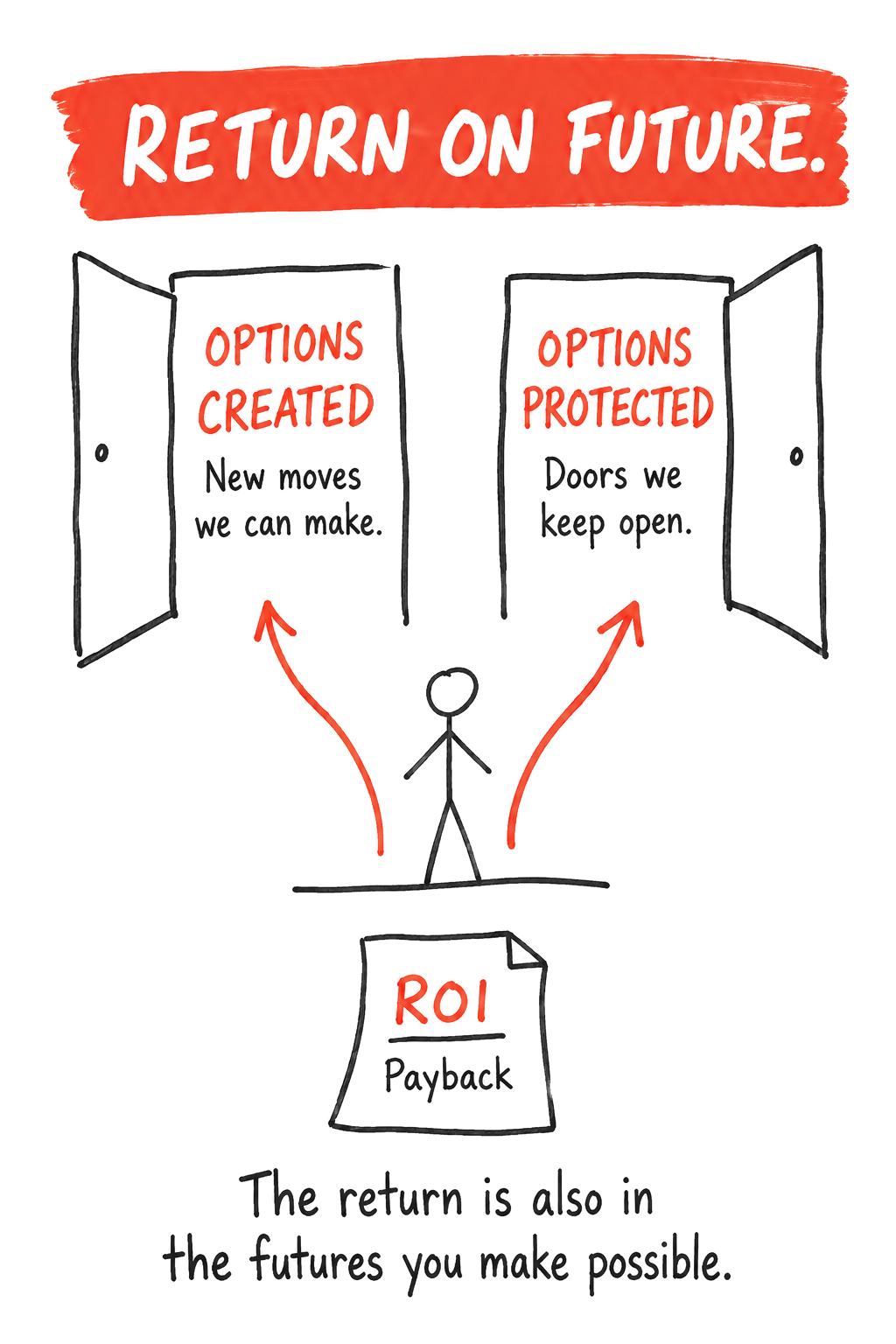
Return on Future is the strategic value of the options an investment creates, preserves, or protects, before its full economic payoff can be credibly modeled. The load-bearing word is options. Not benefits, not vague upside. Options: the right, but not the obligation, to do something later that you can’t do today. This isn’t a new idea in finance. It’s real options thinking, decades old. What’s new is bringing that logic into the buyer’s business case, where it almost never shows up.
ROF comes in two forms, and a big bet usually carries both.
Option creation is the upside. Take a company replacing aging network infrastructure with a modern platform. The near-term ROI is real: lower cost, less downtime. The larger value is the doors it opens: new AI-driven services the old network could never run, new markets, new data it can now collect and compound. None of that is on today’s spreadsheet, and all of it is why the sharpest buyers say yes.
Option preservation is the other half. A security or compliance investment is the classic case. A breach has a cost you can model. But it can also foreclose futures: markets you can no longer sell into, partners who walk, trust you can’t rebuild. The value isn’t only the incident you avoid. It’s the entire set of options you protect.
Strategic value is what you can’t count but can’t afford to miss. Harder to quantify. Not less real. It’s the horizon you climbed for.
How to frame it with your champion
Build the options list together, not for them. Sit down and name the specific future moves the investment creates or preserves. A future your champion helped put into words is one they’ll defend in a room you’ll never enter.
Name the doors that close. For every option, ask the harder question: what happens to this choice if we do nothing or wait a year? When a future option quietly disappears with inaction, you’ve just found real urgency.
Tie it to strategy the executives already fund. The most credible ROF is a bridge to an initiative leadership has already committed to. When your solution is what makes their stated strategy possible, ROF stops sounding soft. It becomes the reason the bet is not optional.
Next Steps
Pull up your most important open deal and ask an honest question: have you built all three returns, or just the one you already know how to count?
- Walk your top three open deals and mark which of the three returns each one is missing.
- If you want help building the full climb into your next business case, let’s talk.
- I’d love your feedback: where has Return on Future decided a deal you almost lost on ROI alone? Hit reply, comment, or connect with me on LinkedIn.
Most business cases stop where the math stops. That’s exactly where the biggest value in a big bet begins. Help your champion build all three, and buyer and seller end up on the same step, looking at the same horizon.
So: which step is your last business case still standing on?
Author
Bruce Scheer is the author of Amazon Best Seller Inspire Your Buyers. He helps B2B revenue teams build value cases their buyers can defend internally and get approved, across the three returns that decide a big bet. Connect with him on LinkedIn.
Research cited
- The JOLT Effect, Dixon & McKenna, 2022: 40 to 60% of qualified B2B pipeline ends in “no decision.”
- TrustRadius, 2024: 79% of B2B purchases require CFO approval.
- G2, 2025: 57% of B2B buyers expect to see ROI within three months.
- SBI Growth Advisory, 2024: for bold purchase decisions, the buying experience drives 59% of the decision versus 41% for the offering.
- Bain & Company, 2026 B2B Growth Agenda: 49% of companies cite product differentiation as their biggest value-proposition problem.
For more sourced, graded B2B statistics like these, see the 2026 B2B Narrative Statistics page.
Frequently asked questions
What is Return on Future (ROF)? The value a decision creates or protects that a standard business case never counts, the options it opens and the doors it keeps from closing. It answers “what future does this create, and what future does it protect?”
What are the three returns in a big-ticket deal? ROI asks “will it pay back?” ROE asks “can we buy this well and carry it to a yes?” ROF asks “what future does this create and protect?”
Why do most business cases miss Return on Future? Because most stop where the math stops. ROF captures strategic optionality that’s real in finance but rarely priced, so it’s the value teams leave uncounted even though it can decide the deal.
How do you frame Return on Future with your champion? Build the options list together, name the doors that close if the buyer does nothing, and tie it to a strategy the executives already care about.