
ARTICLES
The ROI of ROI
Whose fingerprints are on the ROI analysis in your pipeline — yours, or your buyer's? That one question predicts whether the deal gets funded.
By Bruce Scheer, Inspire Your Buyers®
Whose fingerprints are on the ROI analysis sitting in your pipeline right now? Yours, or your buyer’s?
That one question predicts whether the deal gets funded.
There’s a chorus out there telling you to put the ROI analysis down. Don’t lead with ROI. Buyers don’t trust a vendor’s numbers. And there’s real data behind the doubt: presenting ROI at any point in the sales process correlates with a 27% drop in close rates (Gong Labs).
I’ve heard every one of those objections, and that Gong number is real. But it caught a bad habit, not a bad tool. It measured sellers presenting their ROI, the vendor’s number, dropped on the buyer’s desk to accept or argue with. The issue was never the ROI. It was whose ROI it was.
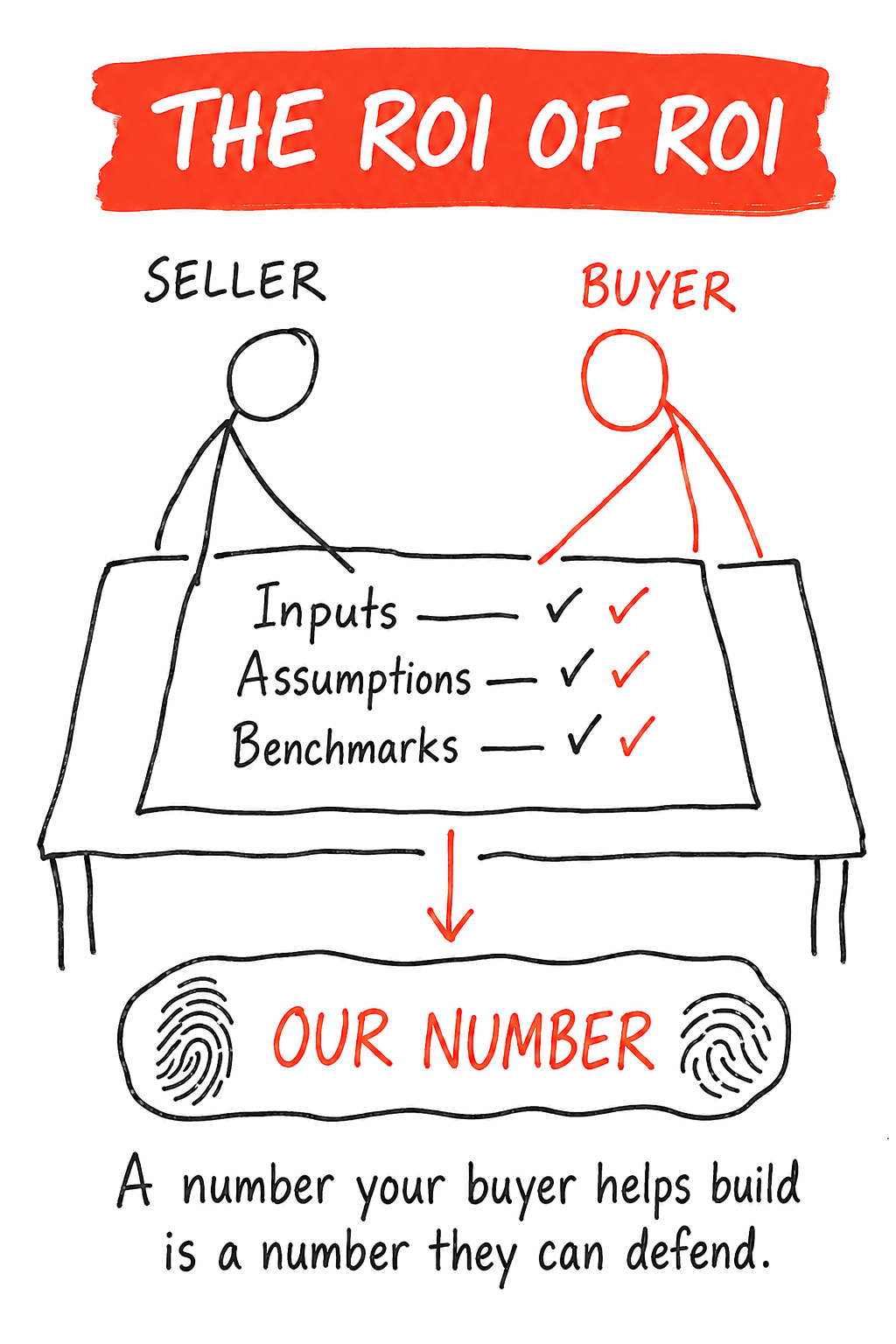
When the analysis is yours, the buyer reads it like marketing. When the analysis is theirs, they carry it upstairs and defend it like their own reputation is on the line, because it is. That’s the whole game, and it’s what it means to help your buyers buy with ROI.
The Big Problem: an analysis nobody owns
In twenty-five years of building value calculators, my rough count is that maybe one in ten sellers even attempts to build the business case with their buyer, and fewer still do it well.
Ask a room of sellers why, and you hear the same four things. It’s too hard, and I’m not a finance person. The buyer won’t believe my numbers. Value engineering owns that, and they’re swamped. And the deal feels like it’s moving, so why slow it down with a business case?
Each has a grain of truth. Together they add up to a seller handing over a glossy, vendor-built ROI the buyer had no hand in shaping. It reads like a brochure, full of fuzzy math and hyped-up assumptions, and it dies quietly the moment a CFO asks where the number actually came from.
Meanwhile the buyer is drowning on their own. Faced with too much high-quality but conflicting information, buyers are 153% more likely to settle for a course of action smaller and less disruptive than they first planned (Gartner). Left alone with the numbers, buyers shrink the deal, or they shelve it.
The Risks: where deals go to stall
40 to 60% of qualified pipeline ends not in a competitive loss but in “no decision” (The JOLT Effect, Dixon and McKenna). Your buyer isn’t choosing your competitor. They’re choosing nothing, because they can’t build enough conviction to choose at all.
Now add the gatekeeper. 79% of B2B purchases require CFO sign-off (TrustRadius). Picture your champion walking into that CFO’s office holding your ROI deck. They didn’t build it. They can’t defend the assumptions. The CFO asks one hard question about the payback, and your champion folds, because it was never really theirs to defend. Every big-ticket purchase is a big bet for the buyer, and your champion is betting their credibility on this working. They will not place that bet on a spreadsheet covered in your fingerprints and none of their own.
And when you can’t make the value case, you compete on the one thing left: price. A real analysis protects your price the way the big-four consultancies protect theirs, by pricing the value of the outcome, not the hours behind it.
The Desired Outcome: an analysis with the buyer’s fingerprints on it
Now picture the opposite. You don’t present a finished ROI. You build one with your buyer, using their inputs, their assumptions, their benchmarks, in their language. Somewhere in that process the thing changes hands. It stops being your claim about their business and becomes their conviction about their business.
The numbers are striking. Across 2,960 sales opportunities at five B2B SaaS companies, deals with an engaged buyer collaborator in the value assessment won at 3.4x higher odds (Ecosystems). And here’s the part that should stop you: in that same data, the polished bottom-line ROI figure correlated only weakly with closing. What moved the deal was the engagement, the buyer in there changing inputs and arguing with the model. That’s the very thing Gong’s 27% was measuring from the wrong side. Present the number and it repels. Build the number together and it convinces.
It also forces the alignment that matters most. Win rates climb roughly 38% when buyer and seller agree on the core problem, yet only 45% actually align after discovery (Corporate Visions and Emblaze). You cannot co-build an honest ROI without first agreeing on the problem it solves. The analysis drags the alignment into the open.
The Path: six moves that build the analysis together
This is the deliberate, co-built process I call Quantify Value in my own client work.
Pull up the second chair. Don’t email the ROI. Build it together, on a shared screen, and test every benefit line with them. Some they’ll throw out. Some they’ll fight for. The moment your buyer strikes one line and defends another, the model stops being yours.
Quantify the cost of doing nothing. A real analysis prices the downside of standing still, not just the upside of buying. 57% of buyers now expect to see ROI within three months of a purchase (G2). Put a number on the cost of waiting, because that clock is already running.
Cast the Return on Future. Some value won’t fit in a payback cell, and it’s often the value that matters most: the strategic options an initiative creates or protects, before you can credibly model the payoff. Name it in the case, even when you can’t fully price it. I go deeper on this in Return on Future.
Frame the risks, then mitigate them. A number without a risk section is a wish. Say plainly what could go wrong and what you’ll do together to reduce it. That’s what lets your champion walk upstairs and hold their ground.
Make it real with AI. Use it to find the benchmarks that ground your value claims and to personalize the case to one buyer’s context instead of generic cross-industry math. Keep the three things that make an analysis credible in human hands: defensible benchmarks, real grounding, and collaboration. Your buyer still has to hold the pen.
Don’t stop at the sale. The analysis that lands the deal is the same one that keeps it. Hand your buyer the scorecard, revisit it quarterly, and you’ll have done two jobs at once: you won the deal, and you built the value realization that renews it. That’s the “land it” your buyer remembers, and it’s worth reading alongside Return on Experience, which covers what happens after you hand over the pen.
Next Steps
- If you want a hand building your first few, let’s talk.
- I’d love your feedback: are you helping your buyers buy with ROI, or still handing them one? Hit reply, comment, or connect with me on LinkedIn.
The best ROI analysis you’ll ever bring to a deal is the one you never actually present, because by the time it matters, your buyer is the one holding the pen.
So before your next big deal: whose fingerprints are on the analysis?
Author
Bruce Scheer is the author of Amazon Best Seller Inspire Your Buyers. He helps B2B revenue teams help their buyers buy by finding, communicating and quantifying the real value of change. Connect with him on LinkedIn.
Research cited
- Gong Labs, sales-call analysis: presenting ROI at any point in the sales process correlates with a 27% drop in close rates.
- Gartner, 2019: buyers facing too much high-quality but conflicting information are 153% more likely to settle for a smaller, less disruptive course of action.
- The JOLT Effect, Dixon and McKenna, 2022: 40 to 60% of qualified pipeline ends in “no decision.”
- TrustRadius, 2024 B2B Buying Disconnect Report: 79% of B2B purchases require CFO approval.
- Ecosystems, 2024: across 2,960 opportunities, deals with an engaged buyer collaborator in the value assessment won at 3.4x higher odds.
- G2, 2024 Buyer Behavior Report: 57% of buyers expect ROI within three months of a purchase.
- Corporate Visions and Emblaze, 2024: win rates rise roughly 38% when buyer and seller agree on the problem, yet only 45% align after discovery.
For more sourced, graded B2B statistics like these, see the 2026 B2B Narrative Statistics page.
Frequently asked questions
Should sellers really lead with ROI, given the pushback? Lead with the buyer’s problem, then quantify it together. The pushback is aimed at vendor-built decks buyers never touch. When the buyer helps build the analysis, that trust problem mostly disappears, because the numbers are theirs.
We don’t have a value engineering team. Can smaller teams still do this? Yes. AI has closed the gap: a rep can now frame a defensible, personalized analysis in an afternoon, work that used to sit in a specialist queue for a week.
What’s the one part of the analysis most teams leave out? The cost of inaction. Most cases price the upside of buying and skip the price of standing still.
How is Return on Future different from ROI? ROI models the payback you can count. Return on Future captures the strategic options an investment creates or protects, value that often matters more but won’t fit in a spreadsheet cell.